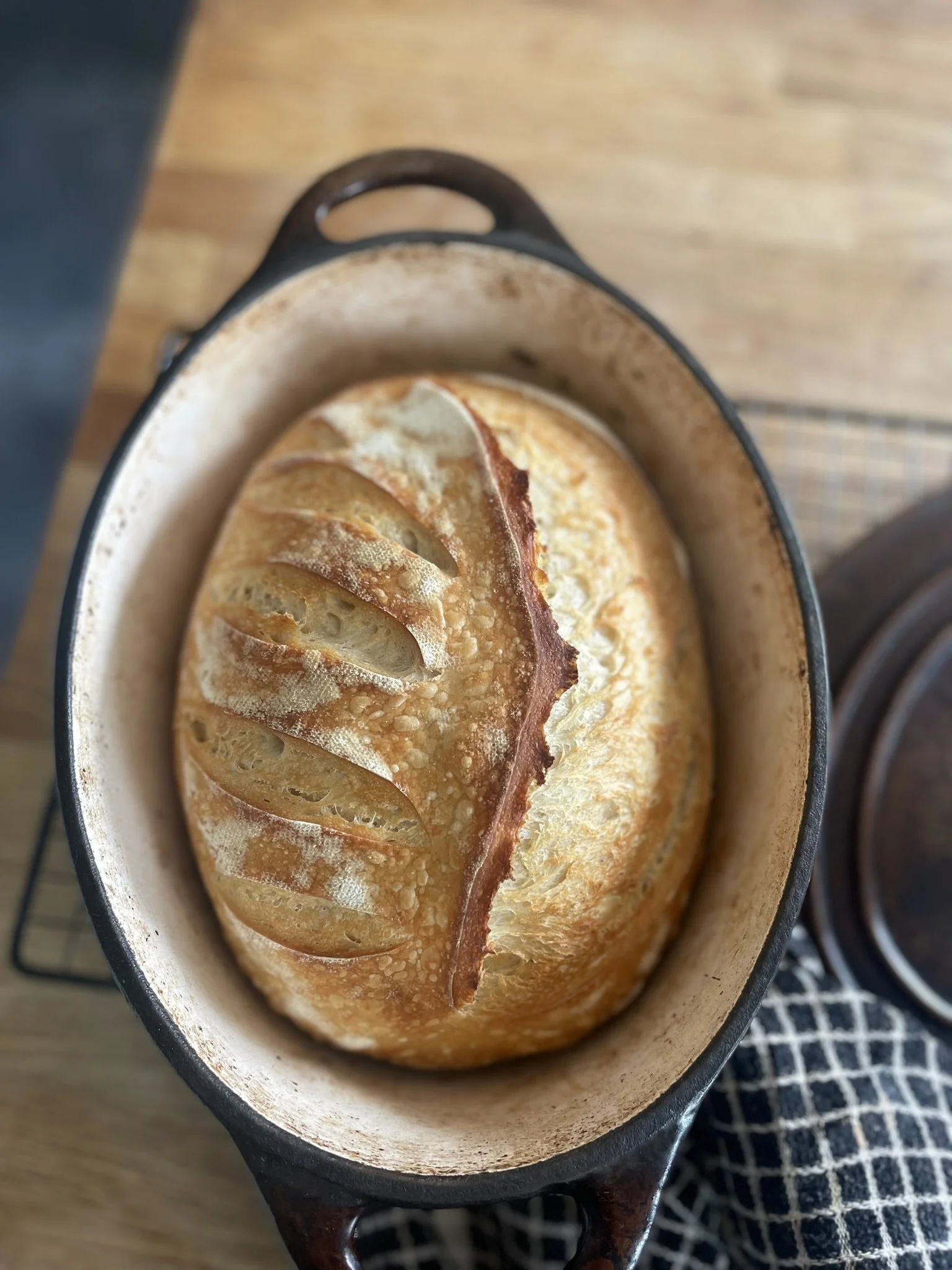
Sourdough starter and a simple white loaf
Starter
How to feed the starter -
Mix 2–3 tbsp starter + 50g water + 50g white bread flour
I keep my starter in a glass jar with a lid, to make starter active enough for baking, take 2-3 tbsp from the jar and mix with 50g water + 50g white bread flour. The rest of the “old” starter is called a discard (it doesn’t mean you have to through it away, you can use it for other bakes, like crackers, etc., share with someone, or make more starter). You can just put the discard in another jar and keep it in the fridge until you decide what to do with it. It accumulates fast if you bake daily.
If kept at room temperature (kitchen) - feed the starter once a day (choose morning or evening).
If kept in the fridge - refresh once a week by feeding it twice in a row (I sometimes only feed it once if it looks bubbly enough).
Example (if baking weekly):
Take the starter out of the fridge in the morning and feed it.
Cover and leave for about 10 hours.
Feed again in the evening.
By the following morning, the starter will be active and ready for breadmaking.
The stages of making a sourdough loaf
Stage 1 - Pre-ferment
For one white loaf:
8g starter + 40g water + 40g white bread flour
Mix well, cover with a lid (silicone cover or clingfilm), and leave to ferment at room temperature:
About 10 hours at 20°C
About 5–6 hours at 24°C
Stage 2 - Dough
All of the pre-ferment + 325g water (room temp) + 510g white bread flour
Mix by hand in a bowl until combined, cover, and rest for 30 minutes.
Add 9g salt, mix thouroughly, cover, and leave for 3 hours in total - read step 3.
During the 3 hour period, fold the dough once every hour (3 folds total). Folding is stretching the outside of the dough and folding it into the centre.
Stage 3 - Shaping
Take the dough out of the bowl, flatten it firmly, fold into the centre, and shape into a ball.
Place into a banneton (or any bowl, bread tin) and refrigerate covered with a tea towel overnight. I don’t have a banneton, I use a bread tin, which I line with a clean tea towel and dust with flour.
Stage 4 - Baking
Preheat the oven and Dutch oven to 240°C (I bake in a Dutch oven but the bread can be baked on a sheet tray too. The Dutch oven gives it a nice crust because placing the lid traps the moisture).
Turn the dough out upside down into the Dutch oven.
Score at a 45° angle with a very sharp knife or a blade.
Bake with the lid on for 25–30 minutes.
Remove the lid and bake until the loaf is well coloured and sounds hollow when tapped.
Print this recipe by simply clicking the PRINT button on your phone or computer, or click here for a condensed version.